If you like shopping auctions, the Olympia area is a pretty good place to live. While there may not be many auction houses within Olympia city limits itself, there are several clustered around Lacey, Tumwater and the surrounding South Sound, with a few more worth the drive farther south.
I wasn’t especially surprised to learn that we have a lot of auction houses around here. I’ve been buying at auctions for years and have visited auction houses throughout Western Washington, including Seattle, Everett, Enumclaw and other communities.
Still, one conversation stuck with me. A representative from Lugg (a hauling service that helps people move large purchases) once stopped by Jade Rooster Auctions with marketing materials I could share with customers. During our conversation, he commented on how many auction houses we have in this area. Hearing it from someone whose work brought him into contact with auction businesses made me realize that we really do have a nice little auction-shopping circuit here in the South Sound.
So I thought I’d put together a guide to the local auction houses I know firsthand.
This guide is for buyers, bidders, collectors, resellers and bargain hunters looking for places to shop. It isn’t a ranking of the auction houses, and it isn’t intended as a guide for choosing someone to sell an estate, collection or household contents. That’s a different subject—and probably deserves a guide of its own.
I’ve personally visited or shopped with every auction business included here, although a couple have moved since my last visit. Along with the basic information about each business, I’ll include a few Kelley’s Notes with the practical details I’ve picked up as a buyer: things like where to go for pickup, which entrance to use, what to expect when you arrive, and anything else that might make your first visit a little easier.
Before you bid: Buyer’s premiums, payment methods, pickup schedules and shipping policies can vary by auction and may change from sale to sale. Always check the terms for the specific auction before bidding.
Sound Auction Service
Lacey, Washington
Sound Auction Service runs frequent online auctions with a wide variety of merchandise. Buyers can preview items in person during business hours, and local pickup takes place at their Lacey location after the auction closes. Their current listings range pretty widely, which makes this a good one for buyers who enjoy browsing mixed estates and never quite knowing what will show up next.
Kelley’s Notes: The big door is usually open. Walk in that one or use the small door. Walk in without ringing the bell first. You’ll want the little office to check in. If no one is there, go back outside and ring the doorbell.
Crawford Family Auctions
Tumwater, Washington
Crawford Family Auctions is a family-run auction house in Tumwater that holds several live and live-online auctions each month. Their auctions often include antiques, furniture, jewelry, art and estate items, and buyers can participate either online or, for some sales, in person.
Kelley’s Notes: I haven’t actually been to their new location yet. They used to be in the old Habitat for Humanity building downtown. Before the move, I remember one of the owners joking that they were tired of people trying to donate toilets to them lol. The old building is now occupied by Olympia Skoolie Thrift. Crawford is now in a nice industrial park and occupies the end unit.
Winning Bid Auctions
Olympia, Washington
Winning Bid Auctions operates from South Bay Road in Olympia and uses HiBid for its online auctions. Their auction mix changes from sale to sale, so this is another one I like to check regularly when I’m looking for local finds.
Kelley’s Notes: It’s easy to miss the turn into this small industrial park. Pull in then make an immediate left.
Jade Rooster Auctions
Lacey, Washington
Jade Rooster Auctions is my own auction business, based in Lacey, Washington. I specialize in antiques, vintage items, collectibles and other secondhand finds that I think are interesting, useful or just plain fun to discover. Auctions are held online, with local pickup in Lacey, and shipping is available on many lots.
Kelley’s Notes: Full disclosure—this one is mine. 😊 If you like vintage glass, antiques, collectibles and curated secondhand finds, Jade Rooster will probably feel the most like my own shopping style. We’re in Lacey Plaza next to Pope John Paul II High School, across from the post office, in Suite 3.
Worth the Drive
Mercury Auctions
Centralia, Washington
Mercury Auctions is farther from Olympia than the other auction houses in this guide, but I’m including it because it’s still within a reasonable South Sound/Southwest Washington auction-shopping trip. Their auctions cover a broad range of estate and collection items, including jewelry, coins, collectibles, glass, equipment and other specialty categories. They also currently hold regular gallery auctions in Centralia, along with auctions in other Western Washington locations.
Mercury Auctions now operates a gallery at 411 E. Union St. in Centralia, while some auctions and pickups are still held at their Chehalis warehouse on Sturdevant Road. Be sure to check the individual auction listing for the correct location before heading out.
Kelley’s Notes: If you’ve been to Mercury in the past, you may remember their Chehalis location. They now also have a newer Centralia gallery, so double-check the auction address before pickup.
Looking for your next vintage-shopping adventure? So am I.
I started this list partly for myself because I’m always hearing about antique shows, vintage markets, flea markets, and other treasure-hunting events after they’ve already happened. I figured other vintage lovers might find it useful too.
Here you’ll find upcoming antique and vintage events around Washington and Oregon, with an emphasis on places I’d realistically consider visiting myself from the South Puget Sound area.
This isn’t meant to be a complete directory of every event in the Pacific Northwest. It’s just a curated collection of shows, markets, festivals, and sales that look especially interesting to vintage collectors, resellers, and anyone who loves a good day of digging for old things.
Event details can change, so I recommend checking the organizer’s website or social media before heading out.
Know of a great PNW vintage event I should add? Send it my way!
You can reach me at: kelley [at] jaderoosterauctions [dot] com
AUGUST 2026
Centralia Antique Fest
Centralia, Washington August 7–9, 2026
An outdoor vintage flea market in downtown Centralia featuring antiques, mid-century finds, primitives, rusty junk, upcycled goods, handmade items and more. Held the first full weekend in August.
Kelley’s Notes: George, The Antique Nomad on YouTube, offers appraisals here for a small donation.
SEPTEMBER 2026
Packwood Flea Market
Packwood, Washington September 4–7, 2026
One of the Pacific Northwest’s largest flea markets, filling Packwood with hundreds of vendors selling antiques, vintage finds, collectibles, handmade goods, tools and plenty of unexpected treasures.
Kelley’s Notes: This market typically runs twice a year, over Memorial Day weekend and Labor Day weekend, so it’s one to watch for every spring and fall.
ThriftCon Seattle
Seattle, Washington September 12, 2026
A one-day vintage convention featuring more than 100 curated small businesses with vintage clothing, streetwear, collectibles, accessories, home goods, furniture and other vintage finds. ThriftCon also includes installations, performances and other vintage-culture activities.
Kelley’s Notes: Seattle appears to be one of ThriftCon’s newer stops, debuting in 2025 and returning to the same Seattle Convention Center location in 2026. This one looks more curated and vintage-clothing focused than a traditional flea market, although there are also collectibles and home goods.
Country Chicks Fall Market
Centralia, Washington September 25–26, 2026
More than 130 vendors fill four buildings at the Southwest Washington Fairgrounds with vintage and upcycled finds, primitives, repurposed furniture, rusty junk, handmade goods, clothing, jewelry and more.
Kelley’s Notes: I haven’t made it to this one yet, but Country Chicks also holds a spring market and a holiday CHICKmas market, so there are several chances to catch it throughout the year.
OCTOBER 2026
The Great Junk Hunt – Salem
Salem, Oregon October 16–17, 2026
A curated vintage market at the Oregon State Fairgrounds featuring vintage finds, home décor, repurposed treasures and other one-of-a-kind goods, along with food, drinks and music. The market runs Friday evening and Saturday.
Kelley’s Notes: This is part of the same Great Junk Hunt series as the Puyallup and Monroe markets. The Oregon State Fairgrounds currently charges $10 for parking, so that’s worth knowing before you go. Kids 12 and under are free.
NOVEMBER 2026
The Great Junk Hunt – Monroe
Monroe, Washington November 6–7, 2026
A large indoor vintage market at the Evergreen State Fairgrounds with three buildings of curated vendors, plus food trucks, music and a full bar. Expect vintage finds, home décor, repurposed pieces and other junkin’ treasures.
Kelley’s Notes: This one takes over three buildings at the Evergreen State Fairgrounds. Parking is currently free in the Red and Yellow Lots, and kids 12 and under are free.
NW’s Largest Mega Sale & Vintage Sale
Ridgefield, Washington November 7, 2026
A huge indoor market at the Clark County Event Center featuring hundreds of vendors selling vintage and antique finds, collectibles, household goods, clothing, tools and plenty of unexpected treasures.
Kelley’s Notes: This event was formerly known as NW’s Largest Garage Sale & Vintage Sale. It changed ownership and is now being promoted as NW’s Largest Mega Sale & Vintage Sale. It can get very warm inside, so wear lightweight clothing or layers you can easily remove. There is also a fee for parking and a separate admission charge.
PNW Flea Market
Bremerton, Washington November 14, 2026
An indoor flea market at the Kitsap County Fairgrounds with more than 100 vendors selling vintage and antiques, collectibles, household goods, tools, clothing, garden items, garage- and estate-sale finds, and plenty of other secondhand treasures.
Kelley’s Notes: This one looks more like a true digging-and-bargain-hunting flea market than a curated vintage show. Parking is free. Early Bird admission from 8–10 a.m. is $15 and includes a PNW Flea Market tote bag; general admission from 10 a.m.–5 p.m. is $5. Admission is cash only, and children 12 and under are free.
The Great Junk Hunt – Puyallup
Puyallup, Washington November 20–21, 2026
A juried vintage market at the Washington State Fairgrounds featuring vintage finds, repurposed treasures, handmade goods and one-of-a-kind home décor, along with food and drinks.
Kelley’s Notes: The Great Junk Hunt got its start in Puyallup in 2009, originally as the Funky Junk Sisters Vintage Flea Market. Puyallup is still considered the original Great Junk Hunt location. Parking for this event is currently listed as free in the Blue Lot.
As an eBay Partner, I may be compensated if you make a purchase through links in this post.
Shopping for vintage glass on eBay can be a little like walking through an enormous antique mall. There are treasures everywhere, but there are also incorrect identifications, ambitious prices, vague condition descriptions, and important details tucked into places where they are easy to miss.
I was recently searching eBay for vintage glass hen-on-nest dishes to add to one of my Pinterest boards. I expected the main challenge to be finding attractive pieces. Instead, I found myself examining each listing for something more important:
Was the seller giving shoppers enough information to make a comfortable decision?
A piece does not have to be perfect for me to consider buying or recommending it. Vintage glass often has wear, mold roughness, small manufacturing irregularities, or even disclosed damage.
My rule is simpler: Imperfect is fine. The seller just needs to be upfront about it.
As a vintage reseller, antique dealer, and collector, I search eBay for all kinds of reasons. I may be identifying a thrift-store find, researching an item for resale, comparing prices, or looking for something to add to my own collection. That means I’m not only looking at the object—I’m also studying the seller’s photographs, wording, condition details, and price.
Here is how I search for vintage glass on eBay—and how I decide which listings deserve a closer look.
Begin With a Simple Search
I usually begin with the most common, straightforward name for the object.
For example:
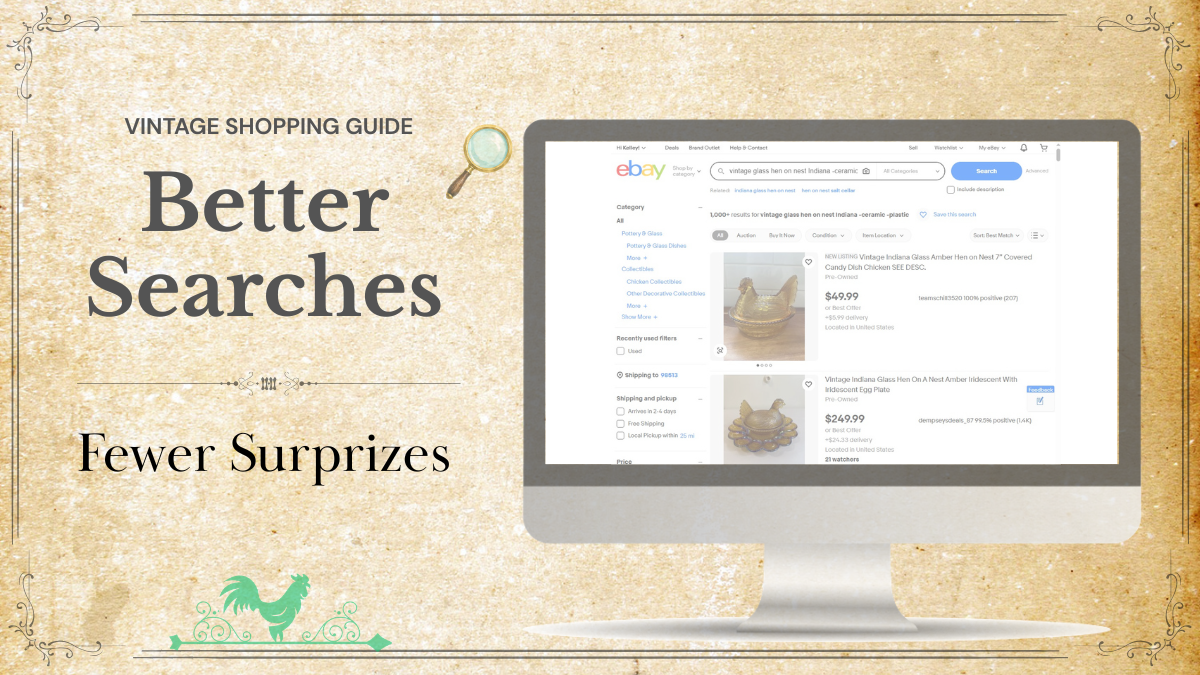
vintage glass hen on nest
Starting broadly helps me see:
The colors currently available
Common and unusual forms
Different seller identifications
The general range of asking prices
Terms sellers use for similar objects
At this stage, I am not assuming that every listing is correctly identified. I am gathering clues.
eBay also provides filters for details such as condition, price, listing format, returns, brand, color, and size. Its Advanced Search offers additional ways to narrow the results.
Where to Find More eBay Search Filters
On desktop, look for Advanced near the upper-right corner of the search area.
On mobile, tap Filter near the upper-left corner of the search results.
Once you open Advanced Search or Filter, you may be able to narrow the results by condition, price, sold status, returns, brand, color, type, item location, and other details.
Available options vary by device, category, and search, but these menus can help you narrow a large set of results quickly.
Add Identifying Details One at a Time
When the first search is too broad, I add the strongest identifying detail I know.
That might be:
Maker
Glass color
Size
Pattern
Material
Object type
A more specific search could look like:
Indiana Glass amber hen on nest
Or:
L.E. Smith jadeite hen on nest
I prefer to add one or two details at a time rather than entering every possible term at once. An overly specific search can accidentally eliminate a good listing simply because the seller used different wording.
For example, a seller may know that an item is a glass hen but may not know the maker. Another seller may use “covered dish” without using “hen on nest” at all.
Try Alternate Names
Sellers do not always describe the same object in the same way.
For hen-on-nest dishes, I might also try:
Hen on nest
Chicken on nest
Nesting hen
Covered hen dish
Glass chicken dish
Hen candy dish
Mini hen salt cellar
This is especially helpful with small hens. One seller may call a piece a salt cellar, while another calls the same form a trinket dish, covered dish, or miniature hen.
Alternate spellings can also matter. Searching both jadeite and jadite, for example, may produce different results.
Remove Unrelated Results
Sometimes eBay begins showing pieces that technically contain my keywords but are not what I am seeking.
When that happens, I may add minus signs before unwanted terms, such as:
glass hen on nest -ceramic -plastic -figurine
I do this gradually. Removing too many words can hide an otherwise useful listing, particularly when sellers add unrelated terms to long titles.
Do Not Treat Asking Prices as Values
An active listing tells me what a seller hopes to receive. It does not tell me what a buyer has actually paid.
When I am judging a price, I look for comparable sold listings whenever possible. eBay’s Advanced Search includes options for completed and sold items, and eBay itself recommends checking completed listings when researching what similar items have sold for.
I try to compare pieces that are genuinely similar:
Same maker or mold
Same size
Similar color
Similar condition
Similar decoration
Original box or label, when relevant
A common amber hen should not be priced by comparing it with a scarce slag-glass example simply because both are hens.
I also remember that an accepted Best Offer may not reveal the buyer’s actual purchase price. A listing displayed at $300 may have sold for considerably less.
Read the Entire Description
This may be the most important step.
A beautiful first photograph and a title containing words such as rare, mint, or excellent can make it tempting to skim the rest of the listing.
That is exactly how shoppers miss statements such as:
“Small chip on the inside rim”
“Hairline crack in base”
“Roughness around both rims”
“Repair near tail”
“Please examine photographs for condition”
During my hen search, I found several listings in which chips or cracks were disclosed only in the written description—not in the title or the brief condition summary.
The seller had technically mentioned the damage, but a casual shopper could easily overlook it. I still do sometimes, especially when a beautiful first photo has already caught my attention.
When a significant crack or chip is present, I prefer to see it plainly acknowledged in the title or at the beginning of the description.
Look for Specific Condition Language
The most reassuring condition descriptions are direct.
Examples include:
“No chips, cracks, or repairs.”
“No damage found.”
“Small chip shown in photograph 8.”
“Mold roughness around the interior rim.”
“Hairline crack in the base; priced accordingly.”
Vague phrases require more investigation:
“Good vintage condition”
“Displays beautifully”
“Condition consistent with age”
“See pictures”
“Minor imperfections”
Those phrases do not necessarily indicate a problem. They simply do not tell me enough by themselves.
I would rather see an honestly disclosed flaw than an unsupported claim of perfection.
Know the Difference Between Damage and Manufacturing Roughness
Pressed glass can have mold seams, straw marks, bubbles, cooling lines, extra glass, or rough areas around mold edges.
Not every irregularity is later damage.
However, photographs do not always make the distinction clear. If a seller mentions “roughness,” I look for a close-up of the area. I want to know whether it appears to be ordinary mold roughness, a small flake, or a sharper chip.
Roughness would not automatically stop me from considering a piece—especially when the seller acknowledges it. Hidden or poorly documented roughness bothers me more than the roughness itself.
Check Whether the Photographs Answer Your Questions
For a covered glass dish, I like to see:
The complete dish from both sides
The lid and base separated
Both interior rims
The inside of the base
The underside
The head, beak, tail, and other vulnerable points
Any maker mark, label, or signature
Close-ups of disclosed flaws
A listing can contain twenty photographs and still avoid showing the most important areas. The number of images matters less than what those images reveal.
When the rims are never shown separately, I assume I still have unanswered questions.
For covered glass dishes, look for photographs of the separated pieces, interior rims, underside, head, and tail—not only the assembled side view.
High Feedback Is Helpful, but It Is Not a Substitute for Details
I pay attention to seller feedback, but a high percentage does not guarantee that every vintage item has been examined thoroughly.
A seller can have thousands of positive transactions and still write a vague description.
Feedback is one part of the decision. I also consider:
The quality of the photographs
The specificity of the description
Whether flaws are acknowledged
The seller’s return policy
How the seller responds to questions
Whether the identification seems supported
A smaller seller can provide an excellent listing, while a highly experienced seller can overlook something important.
Consider the Return Policy
A no-return policy does not automatically make a listing bad. Many responsible vintage sellers do not accept returns.
However, the combination of no returns, vague condition wording, limited photographs, and a high price makes me much more cautious.
When a seller accepts returns, I may be slightly more comfortable with wording such as “good condition,” although I still want to inspect the photographs carefully.
The more expensive the object, the more information I expect the listing to provide.
Be Careful With Unsupported Identifications
Vintage glass frequently changes hands without its original label or packaging. Sellers may rely on another listing, an online image, or family history when assigning a maker.
I am cautious when a listing calls a piece:
Rare
Antique
Fenton
Westmoreland
L.G. Wright
Uranium glass
Victorian
One of a kind
The identification may be correct, but I look for supporting evidence.
That evidence could include:
A maker mark
Original packaging
A label
A documented mold shape
A reliable reference book
A recognizable company color
A clear explanation from the seller
Molds also moved between glass companies, so recognizing a mold does not always prove which company made that particular example.
When I am uncertain, I describe what I can see rather than repeating an attribution as fact.
Include Shipping in the Real Price
A $60 dish with $25 shipping is an $85 purchase before tax.
That does not mean the shipping charge is unreasonable. Glass requires careful packing, and large hen-on-nest dishes can be surprisingly heavy.
I simply compare the complete cost—not only the listing price.
I also consider whether the price makes sense for the condition. A rare color with a clearly disclosed small flaw may still be worth buying. A common color with hidden damage and an ambitious price probably is not.
Save Searches for the Pieces You Really Want
Some of the best vintage finds do not appear the first day you search.
eBay allows shoppers to save searches and receive alerts when new matching listings are added.
I would rather wait for a well-described example than talk myself into an expensive listing that leaves me uneasy.
Saved searches are particularly useful for:
Unusual glass colors
Specific makers
Replacement pieces
Rare patterns
Original boxes
Particular sizes or forms
My Quick eBay Vintage-Glass Checklist
Before buying, I ask:
Identification
Does the maker attribution have supporting evidence?
Could the piece be newer than the seller claims?
Have I checked alternate names or manufacturers?
Condition
Does the seller specifically address chips and cracks?
Are both rims visible?
Are flaws shown clearly?
Is the wording direct or vague?
Price
Have similar examples actually sold?
Am I comparing the same color, size, and maker?
What is the total after shipping?
Seller
Does the seller have useful feedback?
Are returns accepted?
Does the listing feel careful and transparent?
The Best Listing Is Not Always the Perfect Piece
I do not expect vintage glass to emerge from decades of use without an occasional imperfection.
A slightly rough rim, manufacturing bubble, scratch, or clearly disclosed chip may be completely acceptable—especially for a hard-to-find piece at a fair price.
What matters most to me is whether I understand what I am buying.
The best vintage listing is not necessarily the listing with the prettiest object or the boldest claim. It is the one that gives me enough accurate information to make my own decision.
However, not every traditionally styled glass hen is vintage.
Mosser Glass is still producing pressed glass in Cambridge, Ohio, including its familiar 7-inch Hen on Basket. The company also makes animal figures, decorative lamps and many other forms that can look at home beside much older collectible glass.
That does not make newly produced Mosser glass inferior, fake or undesirable. It simply means collectors and sellers should not rely on an old-fashioned design, an opaque color or an iridescent finish as proof of age.
Disclosure: This post contains paid links to eBay. As an eBay Partner, I may earn a commission from qualifying purchases made through these links.
Why Mosser Matters to Vintage Glass Shoppers
When shopping online, I often see newly made glass described as “vintage style,” “Depression style” or simply “vintage.”
Some of these pieces are inexpensive imports. Others are genuine American-made pieces from a company such as Mosser Glass that continues to use traditional pressed-glass methods and designs.
I do not think there is anything wrong with enjoying a newly made glass hen, fairy lamp or covered animal dish. Modern glass can be beautiful, collectible and well made.
The problem arises when its age or maker is described inaccurately.
A newly made Mosser hen is still genuine Mosser Glass. It just should not automatically be represented as a decades-old vintage piece.
A Brief History of Mosser Glass
The Mosser family’s glassmaking history is connected to the Cambridge Glass Company.
According to the company’s history, Orie Mosser worked as the plant manager at Cambridge Glass, where his son Thomas learned the glass trade. After Cambridge Glass closed in 1954, Thomas Mosser began collecting molds and equipment with the goal of establishing his own business.
He began manufacturing glassware in 1959 and established Mosser Glass in 1971. The company describes its product line as a mixture of new designs and classic molds acquired from companies including Cambridge Glass, Viking and L.G. Wright.
Mosser Glass remains family operated and continues to manufacture glassware in Cambridge, Ohio.
That combination of newer designs and historically familiar molds helps explain why some Mosser pieces can look considerably older than they are.
Mosser Glass Still Makes Hens on Baskets
Mosser’s current animal collection includes a 7-inch Hen on Basket in the same general category as its bunnies, birds, turkeys and other pressed-glass animals. The colors and availability may change, but the form remains part of Mosser’s modern product catalog.
Mosser has also promoted newly produced hens through its official social-media account. One company post, for example, announced a Dandelion-colored Hen on Basket in several sizes.
This is important for vintage shoppers because a Mosser hen found at an antique mall, boutique, estate sale or online marketplace may be:
An older Mosser production piece
A more recently produced Mosser piece
A current color or limited production run
A genuine Mosser piece described with an incorrect age
A similar-looking hen made by another company
The appearance of the glass alone may not answer the question.
Modern Does Not Mean “Fake”
I think it is worth making a distinction between a modern piece and a fake piece.
Mosser is a longstanding American glass company making genuine Mosser products. A recently made Mosser hen is not pretending to be something else simply because its design looks traditional.
The confusion usually occurs later, when the piece enters the resale market and its original label, box or purchase information is lost. A seller may assume that opaque green glass is old jadeite, or that a carnival finish must date from the height of carnival-glass production.
Sometimes an incorrect identification is then copied from one listing to another.
Knowing that Mosser is still in operation gives shoppers an important reason to pause before assigning an age.
Mosser Makes More Than Hens
Hens are especially relevant to this series, but they represent only one part of Mosser’s production.
The company continues to offer animal figures, tableware, cake stands, barware and decorative lighting. Its current lamps category includes decorative night lights, while official Mosser social posts also use the term fairy light for smaller collectible forms.
For example, Mosser has produced a limited-edition Owl Fairy Light using original Viking Glass molds. That is a perfect example of how a newly manufactured object can have a strong mid-century or vintage-glass appearance.
Collectors may use the terms fairy lamp, fairy light, glimmer light and night light somewhat interchangeably, although the original company or mold owner may have used a particular product name.
My Mosser Mini Cat on Basket
My own Mosser example is not a hen. It is a small cat-on-basket salt cellar in pale, jadeite-colored glass.
I purchased it at a boutique-style store without being completely certain who made it. Its traditional form and opaque green color gave it a vintage appearance, but those qualities alone were not enough to identify it.
The best clue was hidden inside the base.
A specialized Mosser cat reference identifies this form as the #235 Mini Cat on Basket, a small covered salt cellar. The reference documents the maker’s mark on the inside bottom of the basket rather than on the visible exterior underside.
That location is easy to overlook.
The Outside Bottom Appears Unmarked
When the base is turned upside down, I do not see an obvious Mosser name or logo.
The exterior has molded ribs and a scalloped border, but the flat area on the bottom appears unmarked.
The exterior underside of my Mosser cat-on-basket base appears unmarked.
Someone inspecting only the outside bottom might reasonably assume that the piece has no maker’s mark.
Look Inside the Base for the Mosser Mark
Inside the bottom of the basket is a small molded M surrounded by the outline of Ohio.
The Mosser M-in-Ohio mark is molded inside the bottom of the basket.
Collector references document two marks on this miniature covered cat form:
An older underlined M
A newer M inside the outline of Ohio
My example has the M-in-Ohio version.
The mark confirms Mosser as the manufacturer. It does not, by itself, provide a precise production year.
That is an important distinction. A maker’s mark may identify who produced an object without proving exactly when that particular example was made.
What to Check When Researching Mosser Glass
When I encounter a possible Mosser piece, I would examine more than its color and overall style.
Useful clues include:
Molded marks on the inside as well as the outside
Original foil or paper labels
Packaging and retailer information
Measurements and mold details
Current and archived Mosser catalogs
Official company product pages and social posts
Documented colors and limited production runs
Whether the same form is still being manufactured
Mosser currently provides an online catalog, product collections and a retail price list. Those resources can be just as important as older identification books when determining whether a piece may be recent.
Be Careful With Online Age Claims
An online listing title is a starting point, not proof.
Before purchasing a Mosser hen, fairy lamp or covered animal dish described as vintage, I would look for:
A clear photograph of the maker’s mark
Photographs of both pieces and every side
Exact measurements
Information about where and when it was acquired
Any original box, sticker or paperwork
Evidence that the color and mold were produced during the claimed period
A seller may be entirely sincere and still be mistaken.
The market has become crowded with vintage pieces, modern American glass, inexpensive imports and new “vintage-style” décor. Those categories can all coexist, but they should not be treated as interchangeable.
Shopping for Mosser Glass
Because Mosser pieces can come from different production periods, I would not filter an eBay search to pre-owned items only. Newer and older examples are both useful for comparison.
Paid eBay link. Review each seller’s photographs, measurements, marks and age claims carefully.
A Traditional Appearance Does Not Prove Age
Mosser Glass is an important company for vintage collectors to recognize precisely because it is not a closed glasshouse from the past.
It is a living American glass company that continues to make traditional pressed-glass forms.
A new Mosser hen can be beautiful and collectible. A modern fairy light can come from an authentic vintage mold. A jadeite-colored cat can be genuine Mosser without being an antique.
The goal is not to dismiss modern glass. It is to understand what we are looking at and describe it accurately.
That knowledge helps collectors appreciate both the older pieces and the glass that is still being made today.
Glass hen-on-nest covered dishes were produced by many different companies, and they can look surprisingly similar at first glance.
Fortunately, Indiana Glass hens have several distinctive features that make them easier to recognize once you know what to examine.
For this article, I am using photographs of a blue carnival glass Indiana hen that I previously owned and sold at auction. Its iridescent finish makes the details especially beautiful, but the basic shape and identifying features remain consistent across the many colors and finishes Indiana produced.
Disclosure: This post contains paid links to eBay. As an eBay Partner, I may earn a commission from qualifying purchases made through these links.
A Brief History of the Indiana Glass Hen
The Indiana Glass Company operated in Dunkirk, Indiana, and became one of the country’s major producers of pressed and molded glassware. Collector research traces the familiar Indiana hen-on-nest form to approximately the mid-1930s.
The Dunkirk factory ceased production in late 2002, ending nearly a century of Indiana Glass manufacturing in the city.
Today, Indiana hens remain popular because they were produced over many decades in a wide variety of colors, finishes and base variations.
The Fastest Way to Recognize an Indiana Glass Hen
When I am trying to identify an Indiana hen, I look for these features:
A narrow, flattened tail that points straight backward
A head that faces directly forward
A circular valve mark on the hen’s back
No molded eggs on the cover
An overall length of approximately seven inches
A plain bottom without a decorative pattern
A stippled or striated nest, sometimes with a beaded rim
No Indiana Glass trademark or company name
No single feature should replace a careful comparison, but the combination can make an Indiana hen quite recognizable.
Look at the Flat, Unsplit Tail
The most useful identification feature may be the tail.
An Indiana Glass hen has a narrow, flattened tail that points straight back. It is not divided into two separate sections and does not flare outward into a split tail.
Many other glassmakers produced hens with wider, rounded or distinctly divided tails. If the tail is clearly split, the hen is not the familiar Indiana Glass form.
This feature is easiest to see from directly above or from behind rather than from the standard side view used in most online listings.
The narrow, flattened tail is one of the most useful Indiana Glass identification features.
Check for the Circle on the Hen’s Back
Authentic Indiana hens have a circular impression on the center of the back, between the neck and tail.
Collectors often use this circle as an identifying feature, but it is not a company logo or trademark. It is a valve mark created during the manufacturing process.
Indiana Glass hens are generally unmarked, so you should not expect to find the company name molded into the glass. The circle is far more helpful than searching for a traditional maker’s mark.
The round valve mark on the back is a manufacturing feature found on Indiana Glass hens.
Some newer imported hens closely resemble the Indiana form but lack the circle or show slightly different proportions and comb details. A missing circle should therefore make you pause and investigate further.
Look at the Head and Cover Design
The Indiana hen’s head faces straight ahead rather than turning noticeably to either side.
The cover is highly detailed with molded feathers, but it does not include eggs as part of the design. That absence can help distinguish the Indiana cover from hens made by other manufacturers.
Indiana Glass appears to have used one basic hen cover while changing the nest beneath it over time.
Indiana Glass Base Variations
In Glass Hen on Nest Covered Dishes, Shirley Smith lists five base styles under Indiana Glass. However, newer collector research attributes the cross-hatched version to Hocking Glass. I am including Smith’s original list below, followed by that important identification update.
Cross-hatched base without beads
Stippled base without beads
Stippled base with slotted or open beads
Stippled base with closed beads
Striated base with closed beads
“Stippled,” “striated,” “open beads” and “closed beads” are collector terms used to describe the appearance of the glass. They were not necessarily the names Indiana Glass used at the factory.
My blue carnival example has the later striated nest with a closed beaded rim. The exterior resembles layers of straw or narrow horizontal ripples, while the beads form a continuous border around the top.
This Indiana Glass base has a striated exterior and a closed beaded rim.
A Note About the Cross-Hatched Base
Reference books remain valuable, but glass identification can change as researchers discover old catalogs, boxes and factory records.
Although Shirley Smith attributed the cross-hatched base to early Indiana Glass, newer research identifies the small and large cross-hatched hens as products of Hocking Glass Company.
For that reason, I would not identify a hen as Indiana Glass simply because it has a cross-hatched or basket-weave base.
The standard Indiana Glass hen measures approximately seven inches across the widest part of the dish. Measurements can vary slightly, but an example that is considerably smaller or larger deserves closer investigation.
The underside of an Indiana base is generally plain, without a molded floral, basket-weave or other decorative design.
The standard Indiana Glass hen-on-nest dish measures approximately seven inches long.The plain underside is another useful feature to examine when identifying an Indiana Glass base.
Indiana Glass Hen Colors and Finishes
One reason these hens are so collectible is the variety.
Shirley Smith’s guide documents approximately 29 colors and finishes associated with the Indiana hen. The precise number can vary depending on whether different shades, carnival treatments, frosted finishes and painted or stained versions are counted separately.
Commonly encountered examples include clear, milk glass, amber, olive green and several carnival glass finishes. Other colors can be substantially harder to find.
The hen shown in my photographs appears to be a blue carnival glass example. Its smoky blue glass has an iridescent surface that produces flashes of blue, gold, green and purple as the viewing angle changes.
Be Careful With Painted and After-Market Colors
Color is one of the most complicated parts of collecting Indiana hens.
Indiana Glass itself produced factory-decorated glass. During the 1960s and 1970s, some pieces were sprayed with a paint-like finish and then heated to help the coating adhere. Those finishes were not especially durable and may now show scratches, moisture damage or flaking.
At the same time, ordinary clear hens have also been painted or coated by private owners after leaving the factory. Purple, lavender and unusually bright pink surface treatments are among the colors collectors have reported seeing on altered pieces.
When evaluating an unusual color, examine:
Scratches or flakes that reveal clear or amber glass underneath
Uneven color around the rim or inside the nest
Paint collected in recessed areas
Differences between the color of the lid and base
Whether the color appears in reliable reference material
Whether the seller provides provenance or acknowledges a surface treatment
A painted hen is not necessarily unattractive or undesirable. The important thing is recognizing whether the color is original glass, a documented factory decoration or a later alteration.
Is It an Indiana Glass or Tiara Hen?
Indiana Glass and Tiara Exclusives were closely connected through their ownership by Lancaster Colony Corporation, and Indiana produced a great deal of glassware sold through Tiara’s home-party system.
However, the hen-on-nest dish itself was not sold as a Tiara Exclusives item, despite the frequent use of “Indiana Tiara hen” in online listings.
I would identify these dishes as Indiana Glass hens on nests, not Tiara hens.
Could the Hen and Base Be Mismatched?
Because the hen and nest are separate pieces, lids and bases can become mixed over time.
Check that:
The lid sits securely inside the rim
The underlying glass color matches
The iridescence or surface finish is consistent
The proportions look correct
The base matches a documented Indiana form
Carnival glass can look dramatically different depending on lighting, so slight shifts in color do not automatically indicate a mismatch. Compare the underlying glass near the edges and on the underside rather than relying only on the brightest iridescent areas.
My Indiana Glass Hen
The blue carnival hen shown here has the major features I expect to see on an Indiana Glass example:
A narrow, flat and unsplit tail
A straight-facing head
The circular valve mark on the back
No eggs in the cover design
A striated nest with closed beads
A plain underside
An overall length of approximately seven inches
Shopping for an Indiana Glass Hen
Online listings are not always identified correctly. Sellers may copy another listing or use the Indiana name for almost any large glass hen.
Before buying, compare the tail, valve mark, head position, size and base—not just the seller’s title.
Paid eBay link. Please review each seller’s photographs, measurements, description and condition information carefully.
Indiana Glass hens are a wonderful example of why vintage identification requires more than recognizing a color or general shape. Once you learn to look for the flat tail, circular valve mark and distinctive base, the form becomes much easier to spot.
Next in this series, I plan to look at Mosser Glass hens and the challenge of distinguishing vintage examples from pieces that are still being made today.
Sources and Further Reading
Shirley Smith, Glass Hen on Nest Covered Dishes: Identification & Value Guide, Second Edition, Volume 1
Glass hens on nests are one of those collectibles that seem simple until you try to identify one.
It is a glass hen sitting on a basket-shaped base. How complicated could it be?
Then you begin comparing combs, eyes, beaks, tail feathers, basket rims, base shapes and sizes—and discover that many different American and European glass companies produced their own versions.
Glass hens seem to be having a moment with vintage collectors. With prices rising for some of the more desirable examples, I thought this would be a good time to begin a practical series on identifying them.
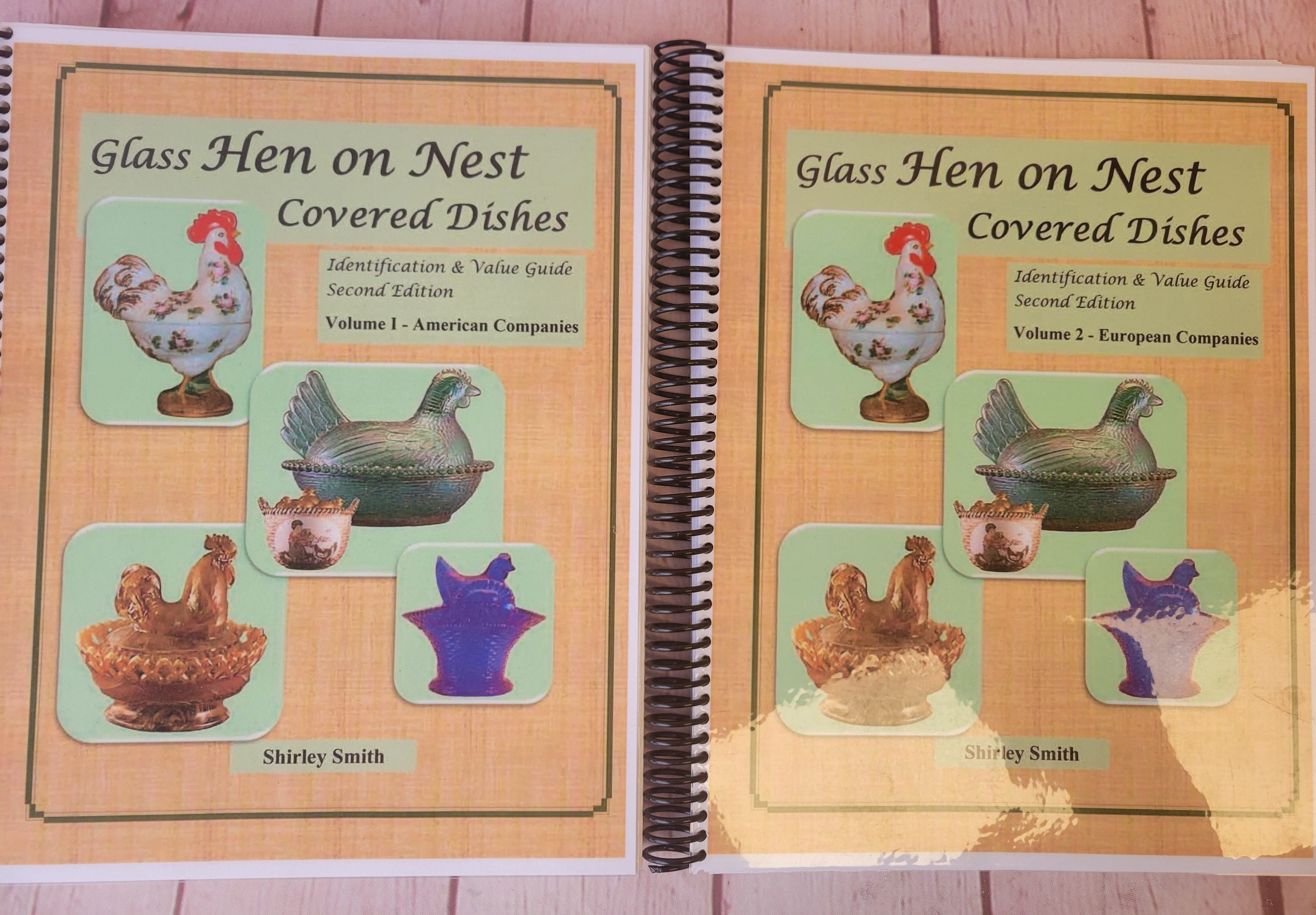
This is the beginning of a small series on my Jade Rooster blog about identifying vintage glass hen-on-nest covered dishes. The natural place to start is with the reference set I already own: Glass Hen on Nest Covered Dishes: Identification & Value Guide, Second Edition by Shirley Smith.
Disclosure: This post contains paid links to eBay. As an eBay Partner, I may earn a commission from qualifying purchases made through these links.
My Starting Point: Shirley Smith’s Two-Volume Reference Set
Shirley Smith’s second-edition guide is divided into two spiral-bound books:
Volume 1: American Manufacturers and Distributors
Volume 2: European Companies
The books were published by Glass Flakes Press, an imprint of the Museum of American Glass in West Virginia.
Together, the two volumes provide an extensive look at glass hen-on-nest covered dishes made by American and European companies. They include photographs, measurements and identifying details that can help collectors compare similar-looking hens.
The spiral binding is especially practical. The books lie flat while I compare a glass hen with the examples shown on the pages.
The title page describes the work as:
“A thoughtful inquiry into the nature of the beast.”
That seems appropriate. Once you begin looking closely at these hens, identifying one can become quite an investigation.
Who Are These Books For?
I think this two-volume set is especially useful for serious collectors, antique dealers and shop owners who regularly need to research glass hen-on-nest dishes. The books are comprehensive, but they can also be expensive. I paid about $50 for my set, so I would not suggest that the average buyer needs to purchase them just to identify one or two hens.
Casual collectors, thrifters and vintage shoppers can simply follow along with this series. I will highlight some of the makers, variations and identification details you are most likely to encounter.
The books cover far more makers and variations than I could reasonably include in a short blog series.
The two-volume set covers an extensive range of American and European glassmakers.
Paid eBay link. Availability, edition and condition will vary by seller.
What Makes a Glass Hen Identifiable?
Color alone is rarely enough to identify the maker of a glass hen.
The details that may help include:
The shape and size of the comb
The shape of the beak and head
Whether the eyes are molded, painted or applied
The arrangement of the tail feathers
The texture of the body feathers
The design around the rim of the nest
The shape and depth of the base
The overall measurements
Any molded marks, labels or signatures
Even the way the hen fits onto the base can be important.
Different manufacturers sometimes produced hens that appear very similar at first glance. Some molds also changed over time, and later glassmakers occasionally produced pieces inspired by older designs.
A good reference book allows you to compare the entire form rather than relying on one feature—or on another seller’s identification.
That last point matters. An incorrect attribution can be repeated from one online listing to another until it begins to look like established fact.
Check That the Hen and Nest Belong Together
A hen-on-nest covered dish consists of two separate pieces, which creates another identification challenge.
The lid and base may not always have started life together.
A replacement lid can sometimes fit reasonably well on a similar base made by another company. Colors can also appear to match in photographs while looking noticeably different in person.
When examining a hen-on-nest dish, I look at:
How securely the hen sits on the base
Whether the size and shape seem properly proportioned
Whether the glass color matches in natural light
Whether the texture and quality of the glass are consistent
Whether the lid and base correspond with documented examples
A mismatched set may still be decorative and desirable, but it should not be identified or priced as a complete original example without further research.
Identification Guide First, Price Guide Second
Although Shirley Smith’s books include values, I consider them identification guides first.
The current market for vintage glass can change. Color, condition, size, rarity and collector demand can all affect what a particular hen sells for today.
An older price guide can tell us what collectors valued when the book was published, but it may not reflect what buyers are currently paying.
For present-day pricing, I also check recent sold listings and auction results. The books are most useful for helping determine exactly what the piece is before researching its current value.
Beginning with Indiana Glass
The next article in this series will focus on Indiana Glass hens on nests.
Indiana hens are among the most recognizable and frequently encountered examples. They were produced in a variety of colors, and they are often the first hens new collectors discover.
They are also frequently misidentified.
In the Indiana Glass article, I plan to look more closely at the features that distinguish an Indiana hen, the variations collectors may encounter and the details that are most helpful to photograph when researching one.
After Indiana Glass, I plan to look at Mosser Glass.
Mosser is especially interesting because the company continues to make traditional glassware. Its hens offer a helpful reminder that an old-fashioned appearance does not automatically mean a piece is vintage or antique.
Other possible articles in this series may include:
How to inspect a glass hen for chips and damage
How to spot a mismatched hen and nest
Commonly confused hen-on-nest makers
Unusual colors and glass treatments
Small hens, chicks and other variations
How to photograph a hen for identification
Reference books and resources for glass collectors
This will not be an attempt to document every glass hen ever made. Shirley Smith already devoted two volumes to that task.
Instead, I want this to be a small, practical series focused on the makers and identification questions that collectors, thrifters and vintage sellers are most likely to encounter.
Continue Your Own Hen Hunt
Part of the fun of collecting hen-on-nest dishes is discovering just how many variations exist.
They can be found in different sizes, colors and types of glass. Pieces that initially appear nearly identical may have been made by completely different companies—or decades apart.
Paid eBay link. Please review each seller’s photographs, description and condition information carefully.
I hope this series helps me become better at recognizing these charming covered dishes while helping other glass lovers avoid a few identification mistakes of their own.







You must be logged in to post a comment.